How we rebuilt springloaded.co in Amp

Co-Founder & CEO
We've been in need of some biz-dev and marketing updates at Springloaded. Not just a refresh of our website, but a tightening of our core offerings and brand positioning. I got all of that done solo, including a full website redesign, in under five days (while also shipping to 4 other apps in parallel).
I'm all-in on Amp. I've been adamant about sandboxing agents from day one, to the point that I've never actually run claude on my machine outside an sbx sandbox.
Cloud agents running on throwaway servers give me everything I ever wanted with sbx, and more. The productivity gains we've seen with Amp are significant. This definitely feels like the way we need to be organizing around software, at least until software becomes a just-in-time endeavour.
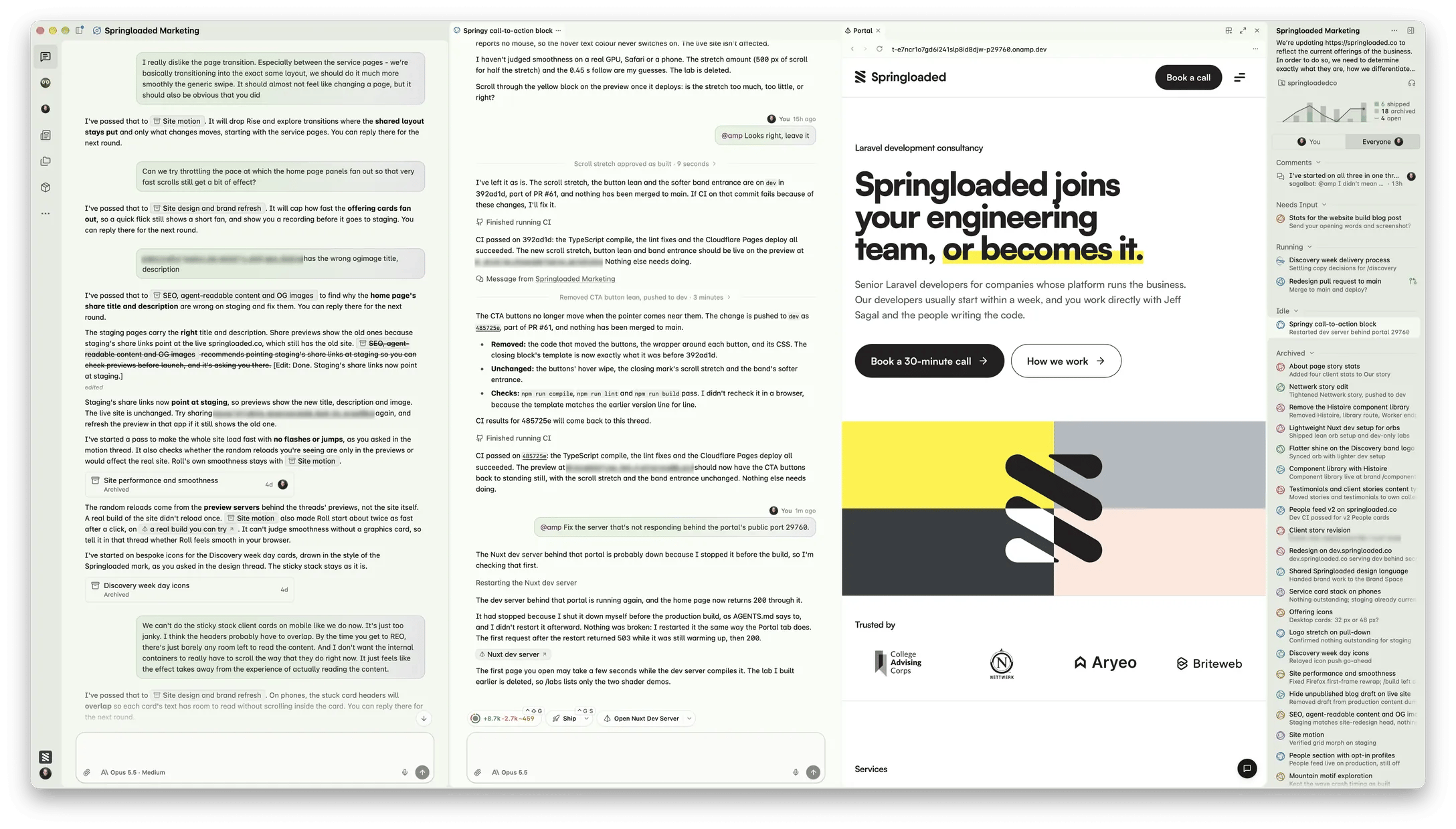
The Springloaded Marketing Space in Amp. From left: the conversation with the coordinator, one thread's report, a live preview of the site, and every thread the Space started.
This process over the last week has really demonstrated the power of shifting the software development lifecycle around the model. Sure, this is just a website and apps are more complex - but it's a product either way. The same process challenges apply all the same.
Code used to be the bottleneck, and that's no longer true. The SDLC needs to adapt to that. The bottleneck has moved to the top: knowing what to build, making the right decisions, and how fast you can turn decisions into action.
When one person owns all of that from top to bottom, the process from decision to action can be essentially instantaneous. When that same person also has a decade of experience, mastery of their tools, and a strong ability to steer a model - whoah. You're on a bullet train.
There is a huge opportunity right now for lean teams with strong product ownership. Those teams will be able to move incredibly fast. There's never been a better (or more important) time to make sure that your product decision-making is fast and agile.
This is a big part of why I think products like Amp are going to be so successful. All the work can happen there. Talk through a product decision with your team, and by the time the decision has landed the model is already making it happen.
Anyways, that's enough of my subjective opinions. I'll let the robots speak for themselves.

The same week, from the agents' records
One person directed 20 AI agent threads in Amp, and springloaded.co went from "Start fresh" to an open pull request in 4 days 15 hours.
Jeff asked Amp to count its own work. From here down, the words, the charts and the page itself are Amp's, drawn from its thread records, its usage reports and the site's git history: how the work moved, where the effort went, how fast it was and what it cost.
- from "Start fresh" to an open pull request
- 4 d 15 h
- of agents working
- 41 h
- of model usage at list price
- $1,037
- inputs from Jeff: 179 messages and 149 choices
- 328
Jeff talked to one coordinator, and it ran the threads
Jeff talked to one coordinator, the Space, which writes no code. It turned each request into a thread with its own brief and its own sandbox, and the threads reported back in a fixed format. Questions came to Jeff as multiple choice.
One coordinator and the 20 threads it started
Each circle is a thread, sized by the measure you choose. The Space, the coordinator Jeff talked to, is in the middle. The 20 threads it started run clockwise from the top in the order they began. A line is the messages two threads sent each other, thicker for more. Select a circle to read what that thread did.
The whole week, Tue Nov 10 to Sun Nov 15.
Press play or drag the slider to watch it happen.
Thread 3 of 20, started Tue Nov 10, 11:01 pm
Set the design direction, built every page and did most of the polish, with 29 commits over 45 hours.
Over the whole week
- Agent time
- 13.8 h
- Tokens
- 251M
- Messages in and out
- 185
- Usage at list price
- $369
Jeff sent it 40 messages and answered 16 of its multiple-choice questions. It made 29 commits.
Messages count Jeff's messages in a thread and the messages it exchanged with other threads. Cost is model usage at public list prices. A circle grows with the thread's own figures as the week plays, and is yellow while its agent was working.
One small request shows the loop the whole week ran on.
Jeff typed one word. 7 min 33 s later the fix was live, checked and reported back.
One real request from the redesign, on Wednesday Nov 11, Pacific time. Each column is who acted, and each arrow is a message or a handoff. Jeff's only step is in yellow.
7:41:11 pm
While working on SEO, a thread finds that an unpublished blog draft is readable on the live site, and reports it.
7:41:25 pm
The Space posts the finding to Jeff with one question: should a thread hide the draft now? 14 s later.
7:42:07 pm
Jeff answers: "Yep". 42 s later.
7:42:19 pm
The Space starts a new thread and writes its brief. 12 s later.
7:42:21 pm
In its own sandbox, the thread reproduces the problem, writes the fix, builds the site and runs the checks. 4 min 52 s.
7:47:13 pm
It commits the fix and pushes it to the live site's branch. Cloudflare deploys it.
7:49:05 pm
It loads springloaded.co to check: the draft now returns "not found" and the blog still works. 1 min 52 s later.
7:49:27 pm
It reports back to the Space: what changed and what it checked. 22 s later.
7:49:40 pm
The Space posts the result to Jeff. 13 s later.
The whole redesign ran on this loop. Over five days Jeff sent the Space 50 messages, the Space started 20 threads, the threads sent it 189 messages back, and it wrote Jeff 69 posts.
Times are from the Space's record, the record of the thread that made the fix, and the commit's time in git. Each is when a message was sent or a response finished.
The work that took the agents least took Jeff most
Brand strategy and positioning took 7% of the agents' time and 30% of Jeff's input. The agents could draft every page quickly. Only Jeff could say what was true.
Every piece of work the agents did falls into one of five kinds, and the work started in that order: brand strategy, positioning, design, development, polish. Open each one to read what happened. The chart marks the one that is open.
Polish took 39% of the agent time
Every piece of work the agents did, sorted into five kinds. Switch the measure to see the same work three ways.
Brand strategy: 0.9 agent-hours, $12.70 of model usage, and 9 messages and 27 choices from Jeff, across one thread.
The first thread read Springloaded's existing material and worked out the offerings, the lead customer and how Springloaded differs. It asked Jeff 17 multiple-choice questions, on which customer leads the homepage, how many offerings there are, what the discovery week costs and what the main call to action is. The strategy was decided 42 minutes after "Start fresh", and ten more answers filled in details later. This was the smallest share of the agents' work, 2% of their time.
Started Tue Nov 10, 10:17 pm. 72% of this work happened on Tue Nov 10. One thread did all of it.
With the strategy settled, a second thread wrote the messaging and the copy for every page. The copy was final 1 h 5 min after "Start fresh", then went through more than 20 revisions as Jeff corrected facts and tone, down to whether the team are engineers or developers. He answered 45 choices here. The agents could draft all of it quickly. Only Jeff could say what was true.
Started Tue Nov 10, 11:00 pm. 61% of this work happened on Wed Nov 11. 3 threads did some of it.
The design was built straight in code and judged on live previews, with no design tool after Figma was dropped on the first morning. The first direction was on a preview 1 h 42 min after the start, and Jeff rejected it the next morning: "Direction is not right." The second, built on the brand's colour blocks, got "I LOVE IT. Keep going." at 12 h 24 min. A separate thread explored a mountain motif in images. Jeff rejected all three mountain directions and chose a wave for one homepage section instead. Icons, share cards and the results cards followed. He steered design in his own words: 38 messages and 4 choices.
Started Tue Nov 10, 11:01 pm. 74% of this work happened on Wed Nov 11. 6 threads did some of it.
Every page was built on the preview site 15 h 55 min after the start. Development also covered the SEO pass, Markdown versions of the pages for AI agents, the staging site, a fix on the live site for a leaked blog draft and the pull request: 10,024 lines added and 2,450 removed. On Thursday Jeff asked where the refreshed brand should live so his other projects could use it. That thread compared four options with him and built a private brand repository with a package and a guidelines site. Development took the most of Jeff's input, 35%. 57 of those 114 inputs were choices: approvals to push, and decisions on the people section and the brand's home.
55 of 63 commits landed on Nov 11 and 12
Commits per day on the redesign and the live site, with pushes to staging. 59 of the 63 commits link back to the Amp thread that wrote them. The checks ran 104 times and passed 96; the rest were superseded or on another branch.
- Commits
- Pushes to staging
The pull request: 61 commits, 273 files changed, 10,024 lines added and 2,450 removed. A push is a distinct pushed commit that started the checks.
Started Tue Nov 10, 11:11 pm. 47% of this work happened on Wed Nov 11. 10 threads did some of it.
Once the pages existed, most of the effort went into how they feel. Motion was 54% of it: page transitions, the fanning offering cards and the logo. The rest was loading speed and accessibility, and making the card stacks scroll smoothly on a phone. The performance work took failed page loads on staging from about 1 in 5 to 0 in 162. Jeff rejected the first page transition outright ("I really dislike the page transition"), and the phone card stacks took several rounds before they scrolled smoothly.
The agent time inside polish
Started Wed Nov 11, 10:39 am. 64% of this work happened on Wed Nov 11. 5 threads did some of it.
Set side by side, the two ends of the pipeline look different. The agents' time went to building and polishing, and Jeff's input went to deciding what the site should say.
Brand strategy and positioning took 7% of the model usage and 30% of Jeff's input
Each kind of work as a share of the model usage and as a share of Jeff's input: the messages he wrote and the multiple-choice questions he answered.
- Share of model usage
- Share of Jeff's input
The same split, in figures
The largest of the five kinds in each column is highlighted. Model usage is at public list prices. A message and a choice each count as one input.
| Kind of work | Agent time | Model usage | Jeff's messages | Jeff's choices | Jeff's input |
|---|---|---|---|---|---|
| Brand strategy | 0.9 h2% | $131% | 9 | 27 | 3611% |
| Positioning | 2.0 h5% | $586% | 18 | 45 | 6319% |
| Design | 5.7 h14% | $17517% | 38 | 4 | 4213% |
| Development | 11.8 h29% | $34433% | 57 | 57 | 11435% |
| Polish | 16.1 h39% | $37937% | 44 | 16 | 6018% |
| Coordination | 4.7 h11% | $697% | 13 | 0 | 134% |
| Total | 41.2 h | $1,037 | 179 | 149 | 328 |
8 of 10 milestones landed in the first 25 hours
The first day carried most of it. Brand strategy, copy, a design direction Jeff liked, every page built, a staging site and a performance pass all landed within 25 hours of "Start fresh".
From "Start fresh" to an open pull request in 4 days 15 hours
Time elapsed since Jeff's first message on Tue Nov 10 at 10:15 pm Pacific. The bar is the whole 4 days 15 hours, with a yellow mark at each milestone.
- Start
- "Start fresh." The first thread starts on brand strategy.Tue Nov 10, 10:15 pm
- 42 min
- The brand strategy is decided: offerings, differentiation and customers.Tue Nov 10, 10:57 pm
- 1 h 5 min
- The copy for every page is final.Tue Nov 10, 11:21 pm
- 1 h 42 min
- The first design direction is on a live preview. Jeff rejects it the next morning.Tue Nov 10, 11:57 pm
- 12 h 24 min
- The second direction lands: "I LOVE IT. Keep going."Wed Nov 11, 10:39 am
- 15 h 55 min
- Every page is built on the preview site.Wed Nov 11, 2:10 pm
- 20 h 30 min
- The redesign is pushed to a staging site on Cloudflare.Wed Nov 11, 6:45 pm
- 24 h 49 min
- Performance pass on staging: failed page loads go from about 1 in 5 to 0 in 162.Wed Nov 11, 11:04 pm
- 3 d 16 h
- dev.springloaded.co shows the redesign behind a secret link.Sat Nov 14, 2:15 pm
- 4 d 15 h
- Pull request #61 is open with all checks passing.Sun Nov 15, 1:15 pm
Each handoff took seconds or minutes
- 21 s
- The Space's median time to answer a message from Jeff, across 50 messages.
- 90 s
- Half of Jeff's 149 multiple-choice answers came within 90 seconds of the question, and 101 within five minutes.
- 21 min
- Median time from a thread starting to its first report, across 18 threads.
A multiple-choice answer has no time of its own, so it is timed to the agent's next turn. The 25-hour bracket is drawn to scale.
Behind those milestones, the threads overlapped. Most of the work happened on Wednesday, with up to seven threads working at once.
The Space ran 20 threads in five days
Each row is a thread. Solid marks show when its agent was working, and the thin line runs from its first activity to its last. The thread that designed and built the site is in yellow. Times are Pacific.
- 1 Brand strategy decided
- 2 Staging review site up
- 3 dev.springloaded.co shows the redesign
- 4 Pull request #61 opened
Gaps of more than 20 minutes between an agent's turns split a mark. The Space was created on Nov 8 and work began on Nov 10.
58% of the agent work happened on Wed, Nov 11
Agent turns per hour across the Space and its 20 threads, Pacific time. Darker is busier. Rings mark hours when Jeff sent messages himself. Each day's total is on the right.
Point at an hour, or tap it, for its counts.
An agent turn is one model response. Answers to multiple-choice questions are not counted as messages.
Up to 7 threads were working at the same time
Threads with at least one agent turn in each 15-minute window, Pacific time. In 54% of the windows with any work, three or more threads were working at once.
4 windows reached the peak; the first is labelled.
Cost wasn't the constraint. Decisions were.
The week's model usage would cost about $1,037 at public list rates, and the sandboxes the threads ran in cost $31.70. Neither set the pace. The decisions did.
About $1,037 of model usage at list price, and $31.70 in Amp credits
The list price is what the same model usage costs at public rates. This week's ran on a subscription, so it wasn't billed.
Each thread runs in its own sandbox. The sandboxes ran for 91 hours, and the agents were working for 36 of them.
Sandbox time was $29.61 of the $31.70 in Amp credits. Jeff's Amp subscription and granted credits covered $28.25 of the credits, and $3.45 came from paid workspace credits. The prices of the two subscriptions are not included.
728 pieces of work, sorted by hand
Each agent thread names the piece of work it is on in a status line. The 728 pieces from the Space and its 20 threads were sorted into the five kinds by hand: whole threads where a thread did one kind of work, and piece by piece for the three threads that mixed them. Brand strategy is the offerings, the lead customer and the differentiation. Positioning is the messaging and the copy. Motion counts as polish, and the brand package counts as development. Design and development overlap, because the design was done in code: deciding how something looks counts as design, and building it counts as development.
Coordination is the Space, the thread Jeff talked to, which routed requests and reports. Each of Jeff's messages to the Space counts toward the kind of work it was about, and the 13 about the process itself count as coordination. A message and a choice each count as one input.
Agent time counts an agent as working when its actions are five minutes apart or less. Model usage is priced at public list rates and split within each thread by the size of each response. Times are Pacific. The figures are a snapshot from Nov 15, 2026, taken from Amp's thread records and usage reports and the site's git history.
The setup behind this week, for your team
Over the week, code never held the work up. Jeff's decisions set the pace, and the agents kept up because of the setup around them: every thread in its own sandbox, one coordinator turning requests into briefs, and reports that came back in the same shape every time.
That setup is what Enable brings to your team. Springloaded sets up your developers to work this way, in your codebase and with your conventions:
- Cloud agents in sandboxes. Each piece of work runs on its own throwaway machine, as every thread in this post did.
- Your conventions, written as skills. How your team names things, writes tests and opens pull requests, written down where every agent reads it.
- A review agent that thinks like your seniors. Built from your senior developers' pull request history, so agent-written code meets the bar they set.
- Pairing until it sticks. Springloaded pairs with your developers until this is how they work, not a tool they tried once.
The agents write the code. Your developers keep the judgment, and the setup turns their decisions into shipped work. See how Enable works.
If you'd rather have Springloaded's developers do the work, they work this way too: Embed puts them on your team, Build takes on a new platform or a rebuild, and Partner is a development team by subscription for a business without developers of its own.